





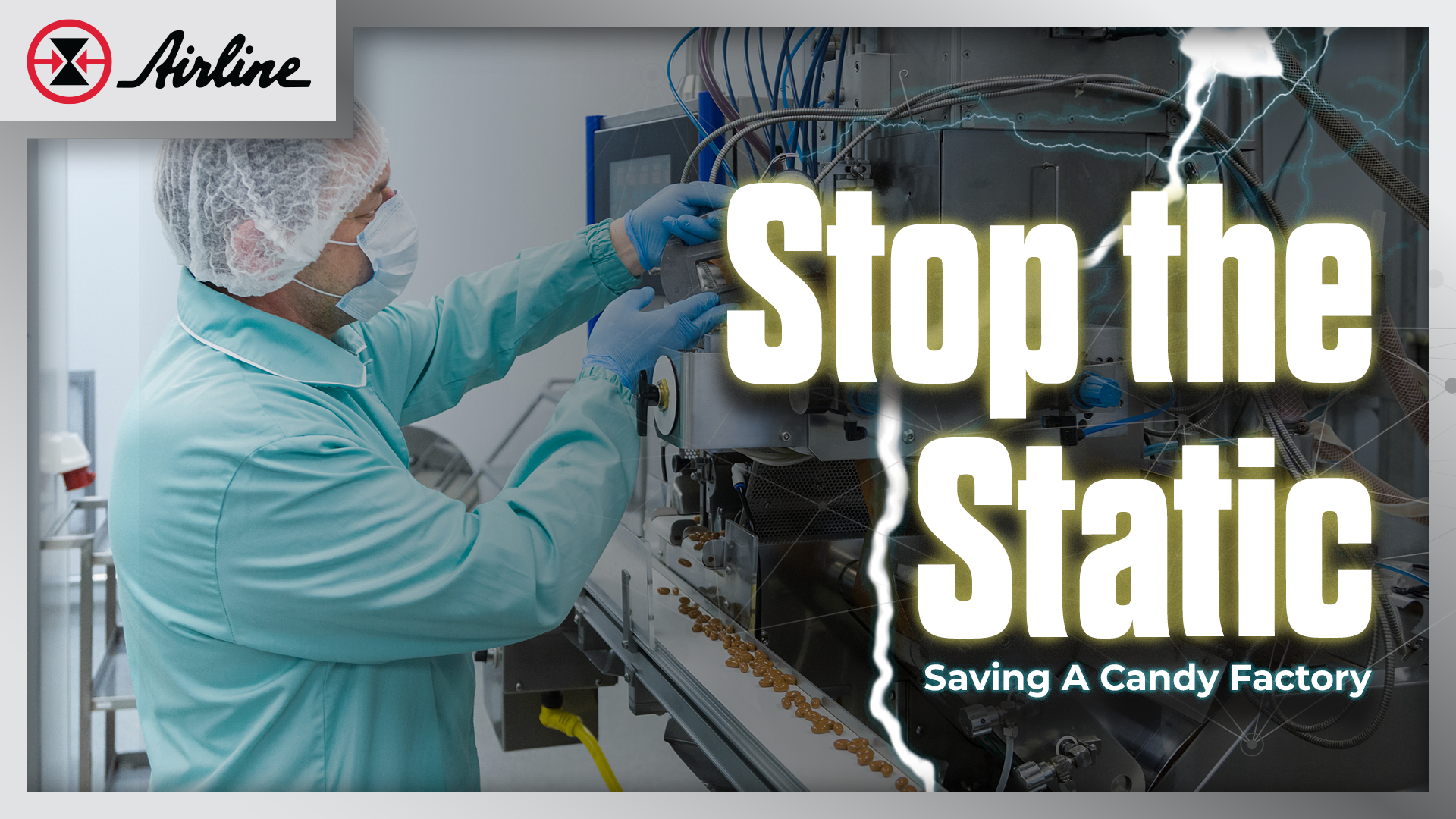

A Charged Situation
A Mid-Atlantic candy maker found themselves in a charged situation with their packaging line, one that threatened productivity and production. The company utilized an air knife system within the line to separate individual candy wrappers, and, once separated, they would be sent down to the next station to wrap a single piece of candy, before making its way to the end of the line.
Unfortunately, the air knife was dealing with static electricity building up along the stainless steel line. When it sent its blade of air towards the wrappers, it was no longer effectively separating a single plastic wrapper - the static wasn't allowing the wrappers to be separated. This led to candy being smothered by multiple wrappers, repeated line stoppages to fix the issue, and a lack of productivity which was causing an efficiency and profitability crunch.
Candy, as we all know, is a sweet business, but it is as susceptible to anomalies affecting production as the next industry. Especially at risk are varieties vital to seasonal shifts and a demanding production schedule, which are absolutely dependent on efficiency. You have a limited amount of time to satisfy the demand for your sweets, and manufacturers simply can't afford to have constant shutdowns.
The company was now facing a conundrum: how to solve the static issue without ripping up the line and starting over. But what was the solution? What is the best way to mitigate static electricity when using an air knife?
Key Takeaways:- Electrostatic Discharge (ESD) can cause havoc on a production line. - An ionizer is potentially the perfect solution to static issues in high-charged environments. - Simple solutions can solve big problems in tight spaces. |
Skip to a Section
A Charged Situation | We've All Been There | Finding the Solution | Enter the Ionizer | Implementing the Solution | The Bottom Line | Additional Resources | FAQs
We've All Been There
It’s a crispy, cold day and you’re in your living room, socks on your feet, shuffling along the carpet. Maybe you’re headed towards a closed door to hit the kitchen. You meander your way over to the doorknob, and it happens: ZAP. You just generated enough static electricity to send a small charge from you to the doorknob.

What's going on?! And how do you stop it? Welcome to the shocking world of Electrostatic Discharge (ESD).
It’s something that we’re all familiar with, and certainly something you thought was funny with friends as a child, but this seemingly innocuous phenomenon that can put a major dent in efficiency on the production floor. Static electricity can build up quickly and negatively affect production, and there must to be a method to mitigate this static build-up. This is where the company found themselves on their vital production line.
Finding the Solution
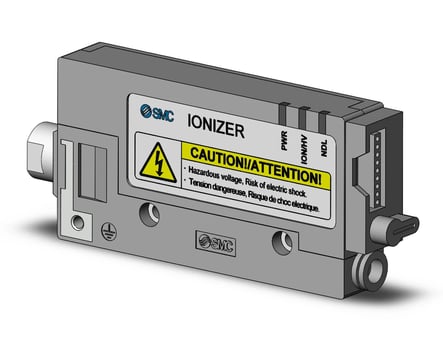
When the company identified the static buildup, they headed to the Internet to gather information, and found that they had a nearby expert who could help them.
“I saw a static basics training video online and realized the Airline Hydraulics team understood static,” said the Director of Mechanical and Electrical Maintenance for the candy maker. “It was the best and most informative video—I reached out and set up a demo.”
Understanding the problem was one thing, but being prepared with a viable solution was another. Airline Hydraulics went to work finding the best way to mitigate static along the line without major changes to the system or major interruptions in production. What they came back with was a simple, elegant solution: an ionizer. “Airline came on site with the SMC IZN10E-11P06 unit and it worked from the start, eliminating 99% of the static,” said the manufacturer.
Enter the Ionizer
Nozzle ionizers emit an air-assisted cone of static-eliminating ions directly at a target. So when dealing with the wrappers, the SMC unit negated the static charge disrupting wrapper separation, allowing the air knife system to "unwrap the wrappers" one at a time, every time. The knife delivered clean, ionized blades of air, and separated each wrapper as intended, allowing it to travel down the line to its next destination: wrapping up a sweet treat.
This specific nozzle ionizer delivers focused coverage for targets two inches or smaller, operating up to 20 inches away. Since the unit was so compact, it was ideal for installation in such a tight spaces and the cartridge can be removed without tools - keeping the line intact and the process as efficient as possible.
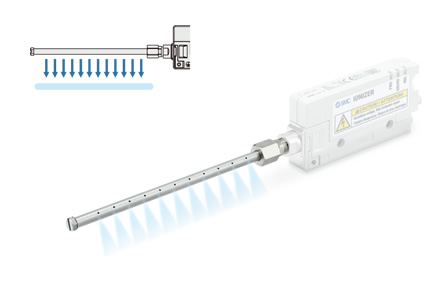
The ionizer is available with a high flow or energy saving nozzle, or female threads to attach an accessory - customize as you need for your specific solution. You can also deploy an optional sensor and monitor to shut the unit down when static elimination is complete or when the target is not present. Tailoring the right model and mounting setup depends on the operational needs of the application rather than standard specs - and you can take a look at the ionizer here: SMC IZN10E-11P06
Implementing the Solution
Placing the ionizer directly behind the air knife ensured that ionized, non-charged air was being blown as its blade, clearing the wrapper clumping problem, and in turn clearing the runway for efficient, solid production. This solution in place, the manufacturer has since outfitted seven more production lines with ionizers.
“I can’t say enough about the product or the Airline team,” said the representative. “You delivered the solution we needed at a cost we could afford, and as we go into the colder months, we do it knowing static has been eliminated on all production machines.”
The practical benefit was clear: the team addressed the cause of the wrapper-separation problem without replacing the packaging line. Airline was able to identify a solution and bring it to life without any negative effects to production, and zero headaches.
The Bottom Line
This candy maker was looking for a simple, cost-effective solution—which could save the existing factory line from major overhauls. So, the mandate was to develop a solution without reworking the whole system. Thankfully, an ionizer proved to be simplest, most efficient, and cost-effective answer. This win-win scenario immediately solved their manufacturing line issues and allowed them to continue to function smoothly.
Repeated packaging stoppages do not always call for a complete equipment overhaul. In this case, understanding where static was disrupting the process allowed Airline to demonstrate a targeted SMC ionizer solution on the existing line.
If static is interfering with your packaging process, our team can help evaluate the application and discuss an appropriate approach. Contact us to speak with an Airline Hydraulics automation specialist about your materials, equipment, and production challenges.

Additional Resources
Best Practices to Remove Static Electricity & ESD in Manufacturing
Why Static Electricity and ESD is a Concern for Manufacturing
FAQWhy were plastic candy wrappers sticking together on the packaging line? In this application, static buildup prevented the air knife from separating individual plastic wrappers. Multiple wrappers reached each candy, causing packaging problems and repeated line stoppages.
Can an ionizer solve wrapper separation problems without replacing the production line? In this case, yes. Airline Hydraulics demonstrated an SMC IZN10E-11P06 ionizer on the existing line. The manufacturer reported that it eliminated 99% of the static during the demonstration. That result reflects this application, not a guaranteed outcome for every packaging line.
Where was the ionizer installed in this application? The ionizer was positioned directly behind the air knife to address static where wrappers were being separated. The installation resolved the wrapper-clumping problem described in this case study. Placement on another line should be evaluated for that application
Who can I turn to solve static-related disruptions? Airline Hydraulics evaluated the problem on site and demonstrated the SMC ionizer. If static is disrupting your packaging process, contact an Airline Hydraulics automation specialist to discuss your application. |



Leave Comment