







U.S. panel shops are under pressure. Lead times are tighter. Skilled labor is harder to find. Customers want smaller panels and faster changes. And a big chunk of build time still goes into one thing: power distribution wiring.
In many IEC-style control cabinets (common across Europe), panel builders often use modular busbar systems as the “power backbone” of the panel. In the U.S., most control panels still rely on point-to-point power wiring and power distribution blocks.
So what drove that difference—and why is the U.S. starting to pay more attention now?
This post breaks it down: what busbar systems are, what they do well, what initially held them back, and why switching now can be a real advantage.
Table of Contents (Jump to a Section):
What is the Busbar System? | Why is the Busbar Popular in Europe? | Why the U.S. is slower to adopt the busbar | Why America is now looking at busbar | Why you should switch now? | Let's Explore Busbars | FAQ's about the Busbar | Resources
What is a Busbar System?
A busbar is a metal bar or strip (often copper or aluminum) used inside electrical equipment to distribute high current power to multiple circuits.
A modular busbar system takes that idea and turns it into a repeatable platform. Instead of building each power path with separate wires, you build around:
- a set of busbars,
- supports and covers,
- and add-on adapters/taps that feed breakers, fused circuits, motor starters, and other power devices.
Think of it like a structured “power highway” inside the enclosure, with standardized ways to connect on and branch off.
Why busbar became common earlier in Europe
There isn’t one single reason. It’s more like a stack of factors that pushed Europe toward “system-based” power distribution earlier.
A big driver: IEC-style assembly standards and design verification
Across much of Europe, control cabinets and low-voltage assemblies often follow IEC standards. IEC 61439, for example, lays out definitions, construction requirements, technical characteristics, and verification requirements for low-voltage switchgear and control gear assemblies.
Modular busbar platforms fit that mindset well because they’re built as a system with defined construction rules, spacing, covers, and repeatable layouts.
A strong focus on standard layouts and repeatable builds
 Many European machine builders try to standardize panels so different techs can build them the same way, with fewer “craft” decisions each time. Busbar supports that by making the power section more structured
A different "default" panel look
A lot of European cabinets are designed to be compact, clean, and easy to service. Using a busbar backbone helps reduce wire routing space and keeps the power section more organized.
Why the U.S. has been slower to adopt busbar systems
To be blunt: the U.S. is behind Europe on modular busbar system in control panels. Not because U.S. shops aren’t capable—but because the U.S. panel world has been built around point-to-point wiring for a long time. It became the default, and once a method becomes the default, it’s hard to replace. Why did this occur?
1) The U.S. lives in the NEC + UL 508A world
In the U.S., industrial control panels are tied closely to NEC requirements and UL 508A practices.
UL notes that NEC Article 409 defines industrial control panels, and that panels must be installed in accordance with their listing and NEC requirements. UL also points out that NEC 409.110 requires several markings, including the panel’s short-circuit current rating (SCCR) and other key electrical information.
When a shop changes how power is distributed, the first questions are often:
- How does this affect SCCR
- Are clearances/creepage addressed
- Will the AHJ accept it?
- What documentation do we need for the build record?
Even if busbar system is a solid technical solution, having to verify these requirements can slow adoption.
2. Short-circuit and spacing concerns feel intimidating
A common worry is: “If we use a busbar system, do we have to do short-circuit testing?”
There are pathways in common UL approaches that allow busbar use without a full custom test program, as long as you design within published limits. One example often discussed in the industry is using UL 508A guidance tied to UL 891 busbar spacing and construction tables (referenced as UL 891 Table G3.1 / UL 508A Table D3.1 in discussions).
Basically, a busbar system is an applicable solution within UL standards, but it does require the shop to be confident in how it’s applied and documented.
3. "Wire it" is a deeply built-in skill set
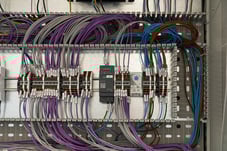
Most U.S. panel techs are trained to build power distribution with wires, lugs, and blocks. Shops have:
- Proven drawings
- Proven layouts
- Proven QA steps
The Busbar system asks a shop to change part of that workflow. Even if the learning curve is short, the risk feels big when you have deadlines.
4. A lot of U.S. teams still see the busbar as "switchgear-only"
Some U.S. builders think of a busbar system as something you do in switchboards or custom copper work—not something you use as a modular platform inside a control panel. That mindset is changing, but it’s still common
Why American panel builders are now looking at busbar systems
Busbar systems haven’t been the default in U.S. control panels, but more panel shops and integrators are paying attention now because the pressure is real: tight lead times, more change orders, and not enough skilled hands to handle all the wiring work. Industry coverage of the control panel market has pointed to labor shortages and disrupted supply chains as major drivers of longer lead times and higher build stress.
When shops compare a busbar “power backbone” to traditional point-to-point distribution, the advantages tend to show up in a few day-to-day places:
-
Less line-side wiring work
-
Traditional distribution can mean repeated cutting, stripping, crimping, labeling, routing, and torque checks for each branch circuit. With a modular busbar system, more devices connect through standardized interfaces, so there are fewer repeat steps. In the right panel types, published performance ranges commonly cited for busbar systems include wiring time reductions up to ~40%.
Keep in mind: results depend on panel complexity, circuit count, and how standardized your builds are.
-
-
Better space use and cleaner power layouts
-
Routing larger conductors eats space fast (bend radius, wireway fill, access). A busbar backbone can reduce wire routing congestion and simplify the power distribution area. Reported space savings for modular busbar layouts are often cited up to ~25% in certain designs.
-
-
Touch-protected power sections (when designed correctly)
-
Many busbar platforms use covers and barriers to reduce accidental contact risk (often described at levels like IP20, depending on layout/components).
Safety note: this helps with accidental contact risk, but it doesn’t replace lockout/tagout, PPE, or your shop’s safety rules.
-
-
Fewer manual connections in the power path
-
Every manual termination is a chance for a wrong landing, missed torque, labeling error, or routing mistake that turns into rework. Busbar system doesn’t eliminate errors, but it can reduce the number of manual line-side terminations—especially in multi-circuit panels.
-
-
Easier adds and late changes
-
When loads shift or circuits get added late, it’s often easier to expand a structured busbar layout than to rework a tight bundle of power wiring. This “add/move/expand” flexibility is one of the most common reasons shops adopt busbar on repeat panel types.
-
-
Lower total cost over the panel’s life (when it’s a good fit)
-
Upfront material cost can be comparable or higher depending on what you’re replacing, but lifecycle estimates often point to 20–30% total cost improvements driven by labor savings, fewer wiring errors, and less downtime during modifications.
{Insert Woehner Battle Card v3 copy}
Keep in mind: if you mostly build one-off panels with few power circuits, the payoff may be limited—busbar tends to shine on repeatable designs and higher circuit counts.
Why switching now can give U.S. panel builders an advantage
A lot of U.S. shops are still competing with the same basic build method: point-to-point wiring and traditional power distribution blocks.
That creates an opening.
If your shop adopts busbar systems before most competitors do, you can be the one who:
- turns quotes faster (more standardized layouts),
- builds faster (less power wiring work),
- reduces rework (fewer manual terminations),
- and fits more into the same enclosure (or uses a smaller one).
Once the busbar system becomes common in the U.S., those benefits become “normal,” and the advantage shrinks. The timing matters.

Explore busbar systems with Wöhner
If you want to see what modern modular busbar system looks like—and get tools that support U.S. panel builds—we offer great starting points from Wöhner (Woehner):
- QCQ (Quick CAD Quote) service (layout + bill of material support).
- CrossBoard overview (modular busbar backbone concept).
- 60 Classic system overview (busbar platform options and ranges)
Check out more information about Wöhner (Woehner) Busbar Systems, and contact us for help with exploring busbar for future projects.


Additional Resources
- Wöhner (Woehner) Modular Busbar System at Airline Hydraulics
- Wöhner (Woehner) Busbar System Flyer
- Wöhner (Woehner) Crossboard Leaflet
- Shop Woehner
- Contact Us



Leave Comment